

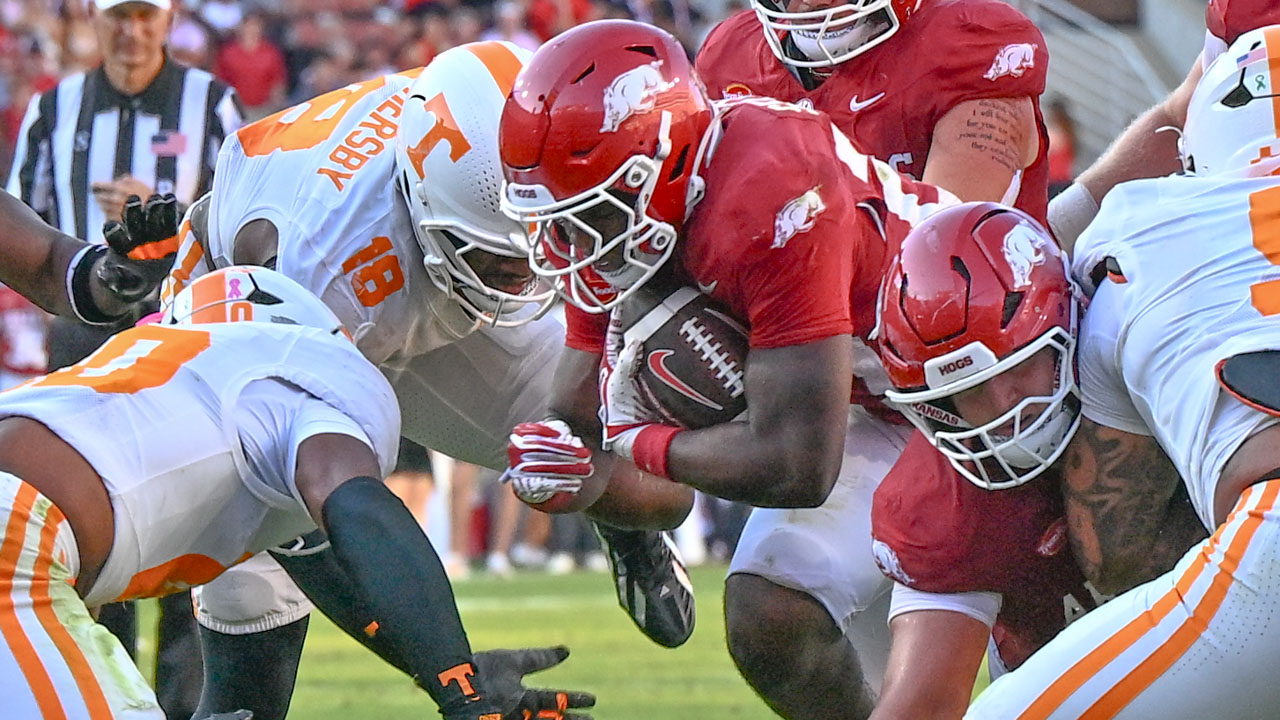
Every Saturday during football season, thousands of fans fill college stadiums to watch young men compete in one of America’s most popular sports.
We cheer for the touchdowns, celebrate the victories, and sometimes hold our breath when a player takes a particularly hard hit.
When he gets up and walks back to the huddle, we breathe a sigh of relief. He’s okay, or at least he appears to be on the surface.
Having watched my three grandsons endure grueling practices followed by physically demanding games, I’ve found myself thinking about something that rarely enters the conversation on Saturday afternoons.
By the time a young man steps onto a college football field, how many hits has he already absorbed?
How many of those hits occurred years earlier, when he was just a little boy who wanted to play football?
For some players, organized tackle football began when they were six or seven years old. By the time they receive a college scholarship, they may have spent more than a decade absorbing hits during practices and games. Some resulted in concussions but many others probably went unnoticed.
We hear a great deal about protecting college athletes from head injuries, and understandably so but I often wonder whether we’re starting that conversation much too late.
Chronic traumatic encephalopathy, commonly known as CTE, is a neurodegenerative disease associated with repeated head impacts.
Researchers have linked it to years of exposure in contact sports, although much remains unknown about who will develop the disease and why.
What concerns me is that a player does not have to suffer a diagnosed concussion for repetitive head impacts to raise questions about his neurological health.
The Centers for Disease Control and Prevention reported findings from a study comparing youth tackle football with flag football. Children playing tackle football sustained substantially more head impacts. The median was 378 impacts per season, compared with eight for flag football players.
Consider a child who begins playing tackle football in elementary school and continues through college. We cannot simply multiply those numbers and predict his future health, but it is fair to ask what years of repeated exposure might mean.
Recent research makes that question difficult to ignore. A 2025 study supported by the National Institutes of Health identified neuronal loss and inflammation in brain tissue from former contact-sport athletes, including some who did not have diagnosed CTE.
Dr. Jonathan Cherry of Boston University, one of the researchers, observed that even athletes without CTE can have substantial brain injury.
A separate 2026 study published in the Journal of Neurotrauma examined 677 deceased former football players.
Among those who died after age sixty, researchers found an association between younger age at first exposure and certain worse later-life clinical outcomes.
The study did not establish that early participation caused CTE, and younger age at first exposure was not associated with CTE pathology in the sample.
Scientists have not identified a precise age at which participation becomes safe or unsafe, nor can they predict which young athletes will eventually develop neurological problems.
But that uncertainty should not prevent us from asking whether we are doing enough to protect our youngest athletes.
As an attorney, I am particularly interested in where responsibility begins and ends. Colleges have established medical protocols to identify concussions and determine when injured athletes can safely return to play.
But how do those protocols account for an 18-year-old recruit who has been playing tackle football since second grade?
His medical records may show no history of concussions, but does the absence of a documented injury necessarily tell the whole story?
Many repetitive impacts produce no symptoms that prompt medical evaluation. I am not suggesting that universities should be held legally responsible for everything that happened to an athlete before enrollment.
But legal responsibility and sound judgment are not always the same thing. The fact that an institution may not be liable for an earlier injury does not mean it should disregard information that could be relevant to an athlete’s present health.
There is also the question of parental consent. Parents enroll their children in football for a variety of reasons, and I understand that.
But how many parents who sign up a seven-year-old for tackle football have been given meaningful information about the potential long-term consequences of repeated head impacts, including neurological problems that may not become apparent until adulthood?
And what about the child who is excited simply to put on his uniform, run onto the field, and be part of the team? The possibility of developing a neurological disease decades later is hardly something he can be expected to understand.
Let me be clear. I am not advocating an end to youth football. But I do believe we need to examine whether certain aspects of contact sports should be introduced at such an early age.
That discussion should involve parents, physicians, coaches, schools, and the organizations that govern youth athletics.
Perhaps colleges should take a more active role in educating the youth programs that produce their future athletes. Universities have access to sports medicine specialists, athletic trainers, and research institutions.
Why not put those resources to work helping parents and youth coaches better understand the risks of repeated head impacts, long before a child reaches high school?
Although college football has devoted considerable attention to concussion protocols and player safety, what troubles me is the possibility that we have concentrated so heavily on protecting athletes once they reach college that we have overlooked the years leading up to that moment.
Perhaps the next important advancement in college football safety will have little to do with what happens inside a college stadium.
Perhaps it will begin on an elementary school football field, years before anyone knows whether that little boy will ever become a college athlete.
By then, I hope we will have done more than teach him how to take a hit. I hope we will have done everything reasonably possible to protect the future he has yet to imagine.
Deborah A. Wilson is a practicing attorney, writer, and avid sports fan. She is the author of the speculative novel The Seam: Secrets Beneath the North Pole.
Disclaimer: This article is intended for general informational and commentary purposes and does not constitute legal or medical advice.