

Hogs Football
Where Razorbacks stand in the SEC-Big Ten antitrust questions
As an SEC member, Arkansas has a stake in whether a possible SEC-Big Ten scheduling deal survives federal antitrust law.

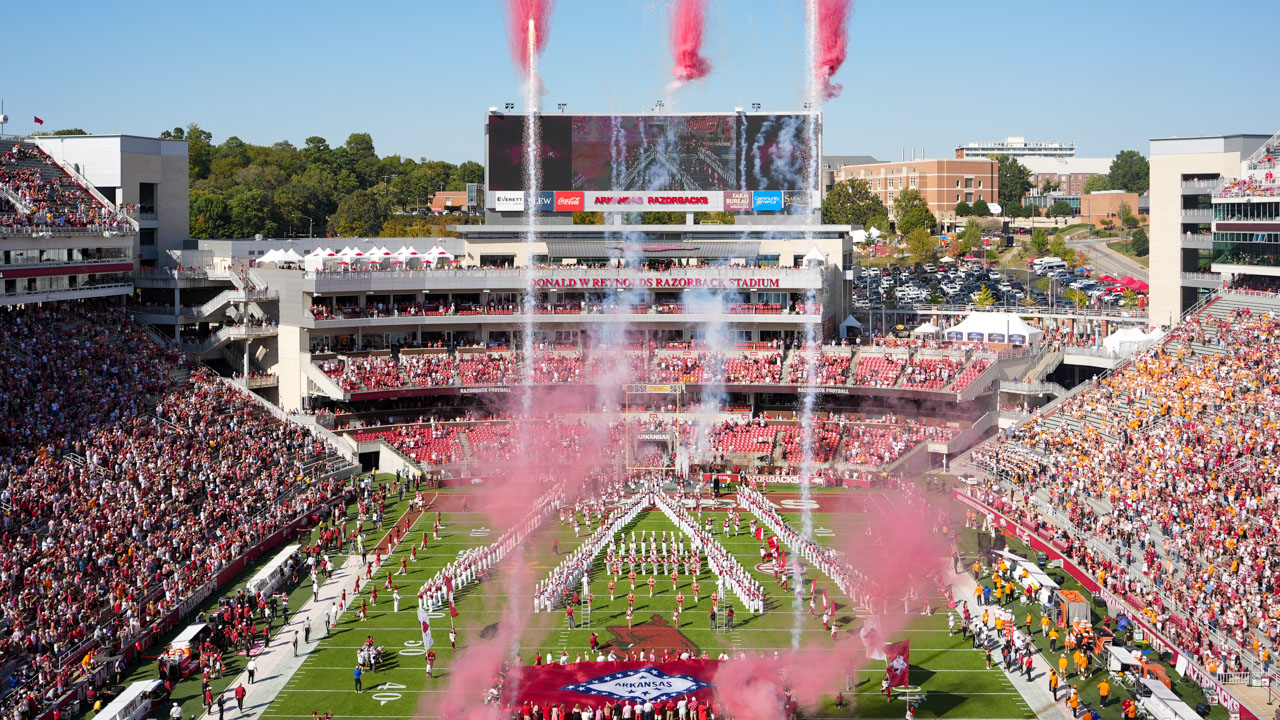
Although there may be very little that college football fans agree on, most would probably agree on one thing: the sport has always been about competition.
Rivalries, tradition, school pride, and the opportunity to compete for a national championship have made college football one of America’s most beloved pastimes.
But as discussions about expanding the College Football Playoff intensify, a different kind of competition is emerging. And this time, the outcome may ultimately be decided in a courtroom rather than on a football field.
Recent reporting by On3, citing FOX Sports analyst Joel Klatt, has raised the possibility of a scheduling arrangement between the Southeastern Conference (SEC) and the Big Ten.
Although Big Ten officials have stated that no specific agreement is being announced, the discussions highlight the growing influence of college football’s most powerful conferences.
Meanwhile, according to an Associated Press report, ESPN could pay approximately $345 million annually in additional television rights fees if the College Football Playoff expands to 24 teams.
Although the proposed arrangement has not been finalized, the financial stakes are enormous.
When cooperation becomes a legal question
These developments raise an obvious legal question, one that may sound familiar: Could cooperation between powerful conferences eventually give rise to antitrust concerns, including unlawful restraints on competition or monopolization?
Under federal antitrust law, there is nothing inherently illegal about becoming successful, powerful, or even dominating a particular market.
However, when cooperation between competitors threatens to undermine the very competition that made their success possible.
Section 1 of the Sherman Antitrust Act prohibits agreements that unreasonably restrain trade. Section 2 addresses monopolization, attempted monopolization, and conspiracies to monopolize.
Stated differently, if the SEC and Big Ten agree to schedule more games against each other, the arrangement could be entirely lawful
But when such arrangements have the effect of excluding other conferences from valuable television opportunities, competitive scheduling, or meaningful access to the national championship, the legal questions become considerably more complicated.
For college football fans familiar with the sport’s legal history, this controversy may sound familiar, and perhaps it should.
College football has been in court before
Are you are thinking Déjà Vu? Your instincts are right because college football been here before College football is no stranger to antitrust scrutiny.
In 1984, the United States Supreme Court decided NCAA v. Board of Regents of the University of Oklahoma, striking down NCAA restrictions on televised college football games because they unlawfully restrained competition.
Nearly four decades later, in NCAA v. Alston (2021), the Supreme Court again applied antitrust principles to college athletics, this time rejecting restrictions on certain education-related benefits for student-athletes.
While neither decision establishes that playoff expansion or a potential scheduling agreement violates federal law, both demonstrate that college athletics is not automatically insulated from antitrust scrutiny.
This leads to an obvious question: Could the SEC and Big Ten create a monopoly?
Before answering that question, let’s first consider what the word “monopoly” actually means.
Most of us are familiar with the board game, where the object is to acquire as much property as possible and dominate the competition. But in the legal world, the concept is considerably more complicated.
Size alone does not make a monopoly
Simply becoming successful, powerful, or financially dominant does not necessarily make an organization an unlawful monopoly.
Courts frequently examine whether an entity possesses monopoly power in a properly defined market and whether unlawful conduct created or maintained that power.
The Atlantic Coast Conference, Big 12, and smaller conferences also have legitimate commercial interests in college football’s future.
However, their inability to command television revenues comparable to those of the SEC and Big Ten would not, standing alone, establish an antitrust violation. After all, competition does not guarantee equal financial outcomes.
But suppose, for the sake of discussion, that coordinated agreements substantially restrict other conferences’ access to valuable television broadcasts or postseason opportunities.
Depending on the terms of those agreements and their effects on competition, legitimate antitrust concerns could arise. The real question, then, is whether such cooperation improves the sport or unlawfully restricts competition.
Universities also face mounting financial pressures, including athletic facilities, travel, scholarships, and commitments to student-athletes. Additional television revenue could help sustain programs that otherwise struggle financially.
Who benefits from an expanded playoff
Federal antitrust law recognizes that cooperation among competitors can sometimes benefit consumers. The challenge, however, is determining when legitimate cooperation becomes an unreasonable restraint of trade.
The reality is that the future of college football is being shaped by conference commissioners, university administrators, broadcasters, and playoff officials. But who will ultimately benefit from an expanded playoff?
Ultimately, there is insufficient evidence to conclude that a potential SEC–Big Ten scheduling arrangement would constitute unlawful monopolization or otherwise violate federal antitrust law.
But that does not mean such arrangements should escape scrutiny.
The real question is whether the system these powerful conferences help create will allow others a meaningful opportunity to compete.
College football may be worth billions, but its enduring appeal rests on something money cannot purchase: the belief that when teams take the field, the competition is real.
Legal Disclaimer: The views expressed in this article are those of the author and are offered solely for informational, educational, and commentary purposes. Nothing contained herein constitutes legal advice or creates an attorney-client relationship. Legal principles and their application may vary depending on the jurisdiction, specific facts, and applicable law. Readers should consult a qualified attorney regarding their individual legal circumstances.
Deborah A. Wilson is a Georgetown University Law Center graduate, a practicing Northern Virginia attorney, and author of the speculative novel The Seam: Secrets Beneath the North Pole.

| Sat, Sep 5 |  | vs North Alabama | W 31-14 |
| Sat, Sep 12 |  | @ Utah | L, 43-10 |
| Sat, Sep 19 |  | Georgia | L, 45-17 |
| Sat, Sep 26 |  | Tulsa | W 34-6 |
| Sat, Oct 3 |  | @ Texas A&M | L, 34-7 |
| Sat, Oct 10 |  | Tennessee | L, 24-17 |
| Sat, Oct 17 |  | @ Vanderbilt | W 31-21 |
| Sat, Oct 31 |  | vs Missouri | 6:45 PM SEC Network |
| Sat, Nov 7 |  | @ Auburn | Early Kickoff 11 AM-Noon |
| Sat, Nov 14 |  | South Carolina | Flex 2:30-7:00 PM |
| Sat, Nov 21 |  | @ Texas | Afternoon 2:30-3:30 PM |
| Sat, Nov 28 |  | vs LSU | Early Kickoff 11:00 AM-Noon |
-
 Hogs Football1 year ago
SEC adopts 9‑game schedule in 2026; Arkansas‑Missouri rivalry likely annual
-
 Hogs Football11 months ago
Razorbacks announce full 2026 schedule with SEC, Utah trip ahead
-
 Eating NWA1 year ago
CJ’s Butcher Boy Burgers keeps Fayetteville’s classic flavor fresh
-

 Eating NWA1 year ago
Oak Steakhouse Rogers: Steaks, service and skyline in NWA
-

 Hogs Baseball3 months ago
Hogs infielder Kozeal drafted by Marlins after big junior year
-
 Hogs Football4 months ago
Razorback fans circle Texas A&M every year but math says stop it
-
 Hogs Baseball5 months ago
Arkansas Got Snubbed by the NCAA Selection Committee
-
 News10 months ago
Razorbacks DL Ian Geffrard hits portal after uneven 2025 season